Execute at machine speed
across every account you manage.
You run managed transportation across many shippers, many systems, and thin margins. Ellie runs the procurement and execution work in every account at once, so coverage and margin go up without headcount going up.
You already know which carriers to call and what the lane should pay. What you do not have is the operator-hours to act on all of it, in every account, fast enough. The execution layer removes the latency between knowing and doing. The work runs continuously, in parallel, the moment a load needs coverage.
“The system of action eats the system of record.”

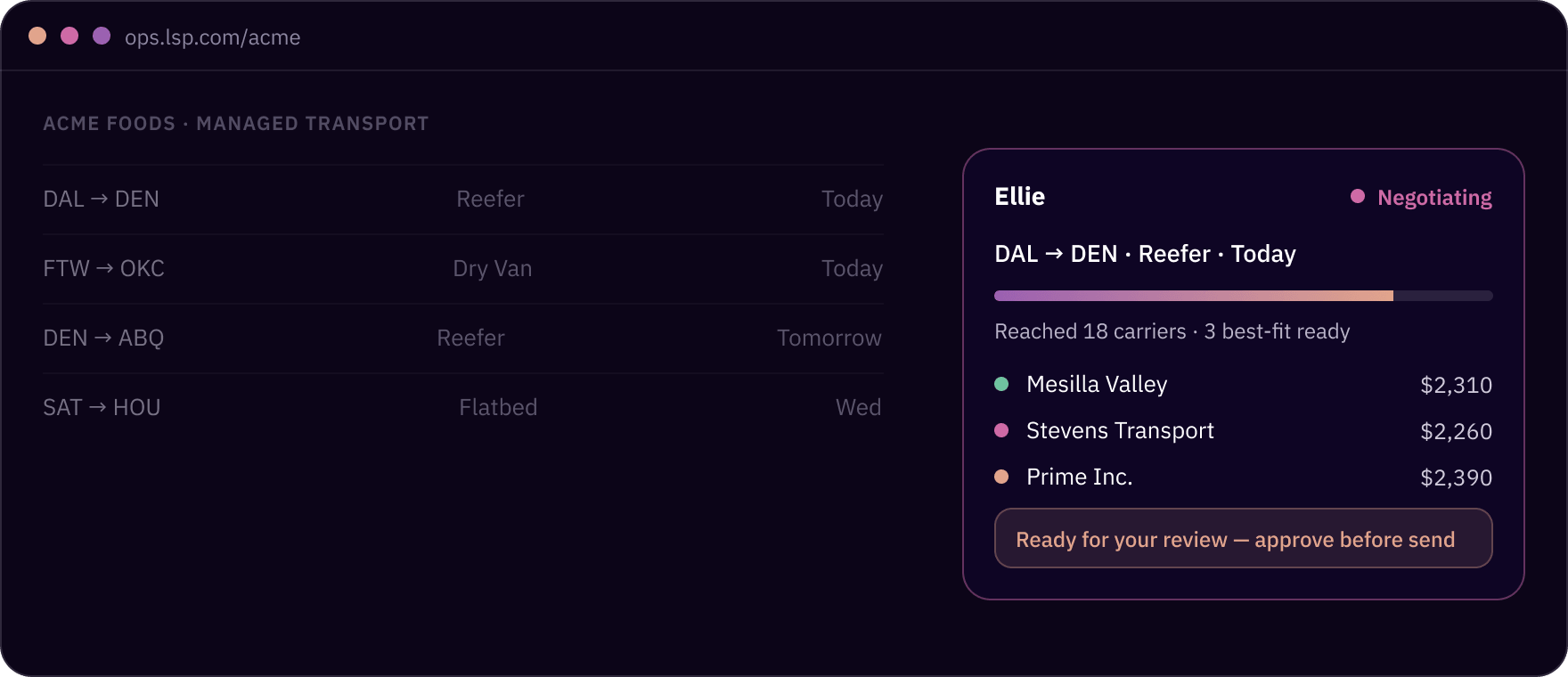
One Ellie, configured per account: their guardrails, their carriers, their brand. The Carrier Context Graph compounds separately for every client you run.
Accounts per operator
One operator supervises Ellie across multiple books instead of running one by hand.
Coverage rate
More loads covered, faster, because outreach runs in parallel and never sleeps.
Cost per load
Execution at machine speed pulls the cost to serve down across the portfolio.
Illustrative ranges; actuals depend on lane mix and account configuration.
Just as the ERP became the system of record, the AI-native execution layer becomes the system of action — the place the work actually happens across every account you manage. Your operators run it. Your clients feel it as coverage and speed.
4
Human oversight
Your operators set strategy and own outcomes
3
AI workforce
Ellie runs procurement and execution per account
2
Semantic layer
The Carrier Context Graph, per client
1
Systems of record
Each account's existing TMS and tools
Can Ellie handle many accounts at once?
Yes. She runs per account in parallel, each with its own guardrails, carriers, and Carrier Context Graph.
How much engineering work is this?
asd
How is this different from point tools?
asd