Execute at machine speed
across every account you manage.
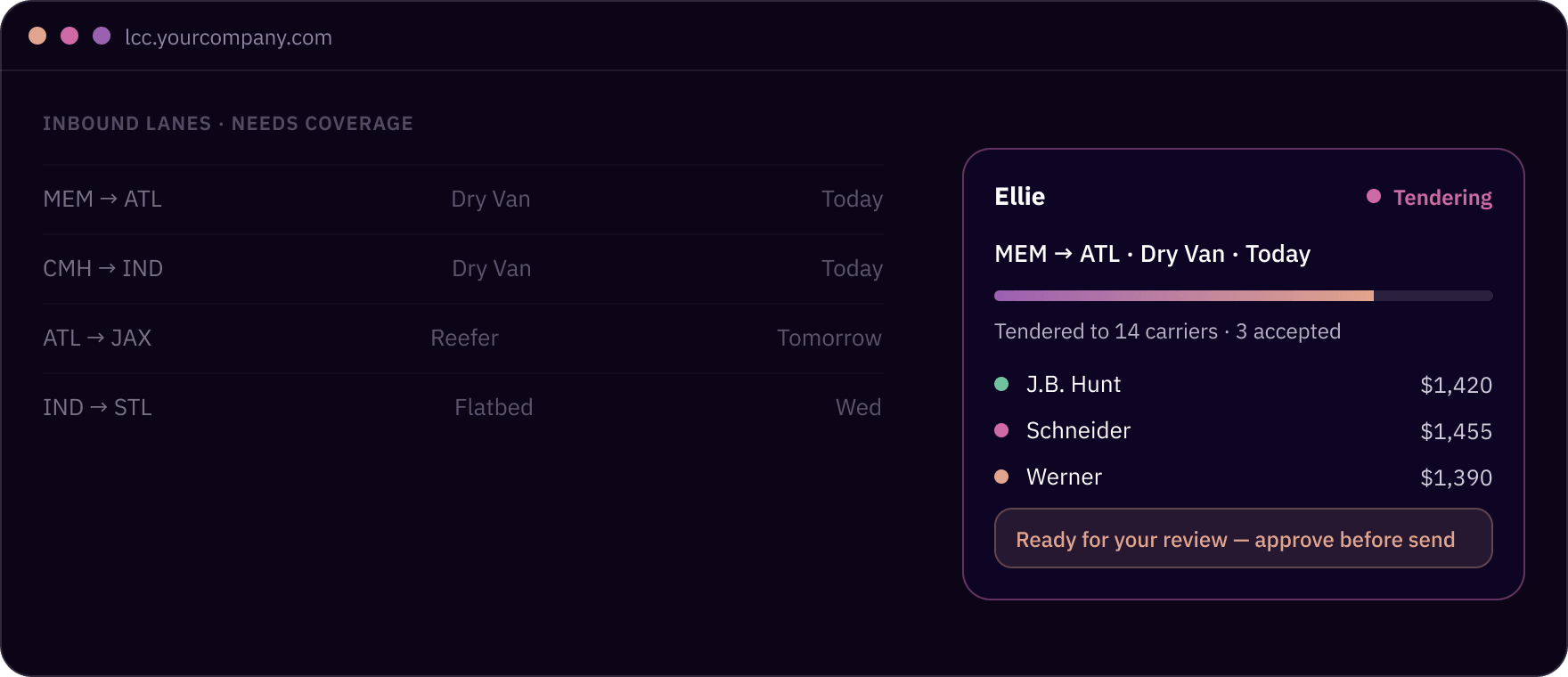
You run managed transportation across many shippers, many systems, and thin margins. Ellie runs the procurement and execution work in every account at once, so coverage and margin go up without headcount going up.
The cost to run carrier procurement in-house was always labor. The execution layer collapses that labor into a small team supervising agents that do the sourcing, outreach, negotiation, and tracking. The capability you used to rent from a 3PL becomes something your own people run, with full visibility and the margin staying inside the building.
“Amazon was the proof the math could work. The execution layer is the proof it can work without a $500B balance sheet.”

Ellie reports the numbers leadership actually asks for: hours returned to the floor, rep capacity freed, loads per rep, cost per load, and the financial impact of the work she ran. Assumptions and SLAs are configurable, so the math matches how your shop runs, not a generic benchmark.
1,240
hours returned / mo
3.4×
loads per rep
-22%
cost per load
$480K
impact / quarter
Illustrative figures. Configured to your assumptions and SLAs.
The old stack put the system of record at the bottom and asked humans to do everything above it. The new stack adds the layer that acts. Envoy calls it TOAS, the Transportation Observability Action System: the observability and action layer that sits above the TMS, makes agent work visible to leadership in real time, and executes against the strategy you set. The system of action eats the system of record.
Human oversight
Strategy & edge cases
The AI workforce
Sourcing → tracking
Semantic layer
Carrier Context Graph
System of record (TMS)
Stores the load
Why bring freight in-house now?
–
Because the cost was always labor, and the execution layer collapses that labor into a small supervising team. The barrier that made outsourcing the obvious choice is gone.
Don't we need a two-year TMS build?
+
asd
What happens to our existing planners?
+
asd